

Nitrile gloves have excellent physical properties and chemical resistance. They are comfortable to wear and rarely cause allergies. They are widely used in medical, food processing, food service, daily cleaning, printing and dyeing, laboratory and electronic product processing. Nitrile gloves with many advantages can be said to be the leader in disposable protective gloves. So, how are nitrile gloves produced? Let us understand the production process of nitrile gloves.
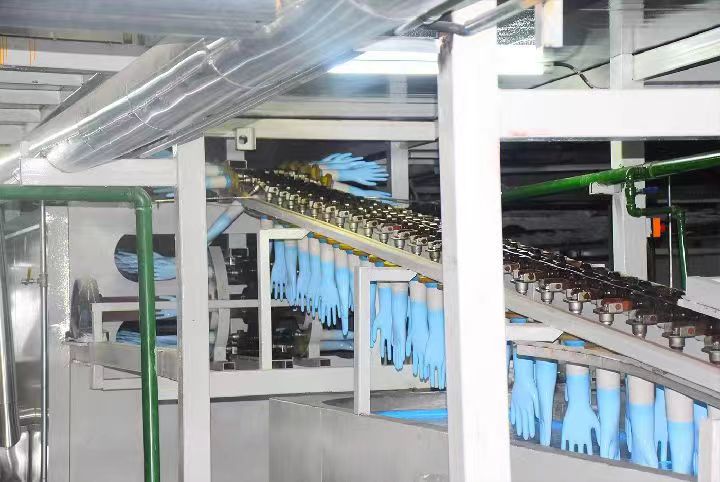
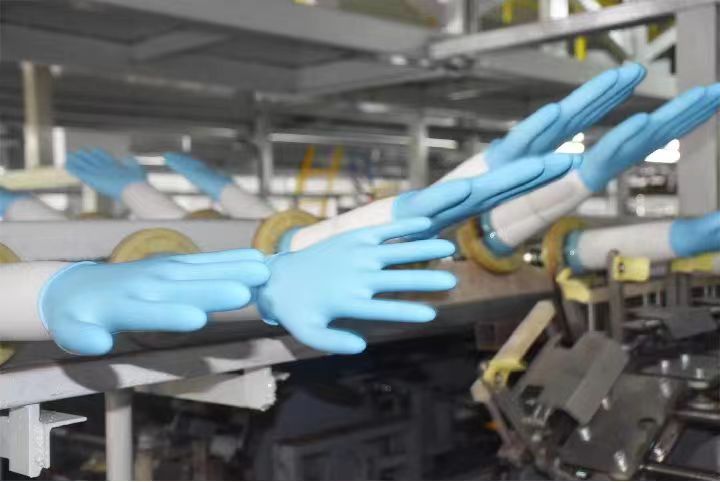

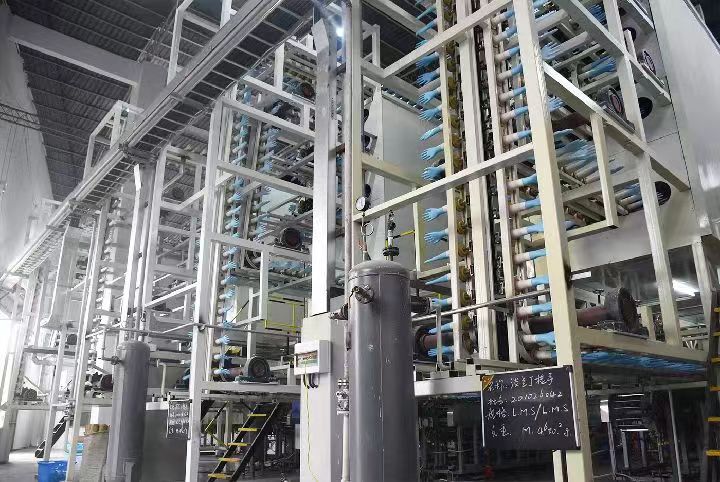
Nitrile gloves are mainly made by dipping nitrile latex, molding, vulcanization, surface treatment, dust-free cleaning and other processes. The specific production process is as follows:
The preferred material for making nitrile gloves is nitrile rubber, which is an emulsion polymerization of butadiene and acrylonitrile.
Then, the hand-washing mold: the hand-washing mold needs to be acid washed, washed first, alkali washed, then washed, etc. After washing the mold, it should be dried or dried before entering the next process.
The third step is to impregnate the nitrile latex to shape the glove. That is, the hand mold is dipped into a container containing nitrile, heated at high temperature, and dried after the glove is formed.
Next, we need to prepare the glove curl to facilitate putting on and taking off the glove.
After the above steps, the nitrile gloves have been formed, but it has not been successful, and a key step is required: chlorine washing. Chlorine cleaning can remove the stickiness from the surface of the gloves and make the gloves softer and smoother, which is an important reason why nitrile gloves are easy to wear.
In the end, the nitrile gloves were separated from the hand mold, and a pair of gloves was successfully born.
The whole preparation process is about the same, but it's not over yet. Nitrile gloves also need to undergo a series of tests, including puncture resistance test, abrasion resistance test, corrosion resistance test, tear test value, gram weight and pinhole test.