

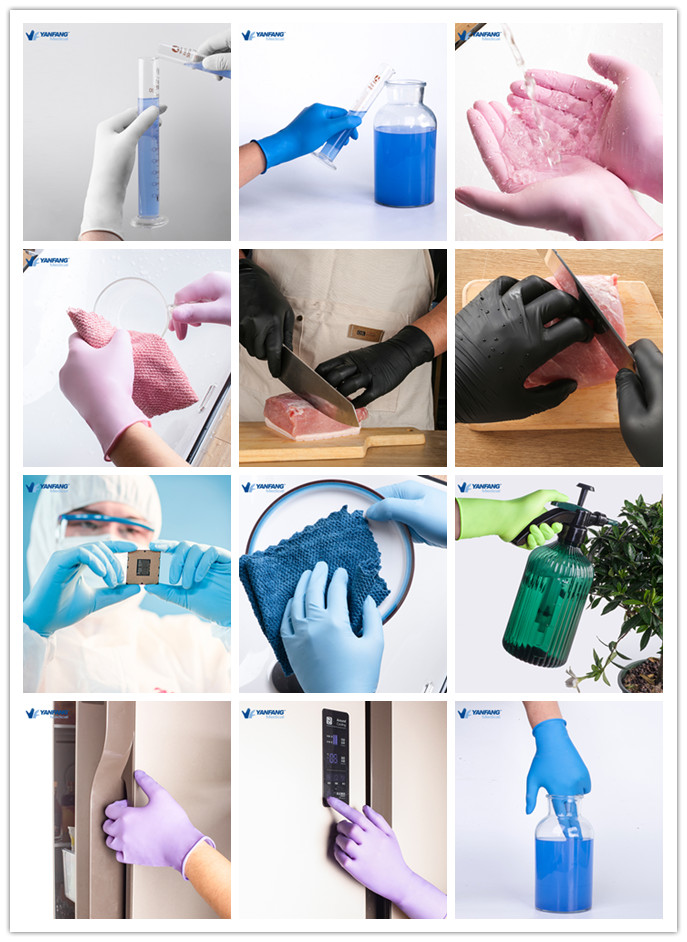
Nitrile gloves are widely used in electronics factory, medical inspection, food industry, housework, chemical industry, aquaculture, glass products and scientific research and other industries. Since the substances in contact with these industries are more harmful to the skin of the hands, the requirements for protection will be higher. Nitrile gloves are recommended over latex gloves. This is determined by the following properties of nitrile gloves.
1. High-density material, chemical resistance, not easy to be corroded by chemical reagents. Compared with the characteristics of poor chemical resistance of latex gloves, nitrile gloves are not easy to be corroded, and can reduce the corrosion of brake fluid, paint, lubricating oil and other chemicals on hands to a certain extent. A protective barrier.
2. Puncture and tear resistance, suitable for high-strength operations. When repairing a car, it is inevitable to come into contact with sharp objects. This feature of nitrile gloves just protects the hands and reduces the possibility of being scratched.
3. Fits the hand shape, and the operation is sensitive. Nitrile gloves will change with the temperature of the hand. Compared with latex gloves, they are more suitable for the hand shape, without pressure, and are suitable for long-term work.
Nitrile gloves maintenance method
1. Nitrile gloves can effectively prevent organic solvents, and their main advantages are high strength and high elasticity. It is mainly provided to the workstations where the hands are constantly exposed to liquid chemicals, such as chemical warehouses, alcohol cleaning, etc. Because the main function of nitrile rubber is to prevent organic solvents, but it is not resistant to puncture, so it needs to be extra careful when using it, do not pull and wear it vigorously, so it is required to wear nitrile gloves when operating. Veil gloves to reduce the wear of nitrile gloves and prolong their life.
2. When wearing nitrile gloves for some cleaning operations, because some products will have some sharp edges, and these sharp edges are the easiest to penetrate nitrile gloves, and once they penetrate even a small hole, it is enough. Let the cleaning agent soak into the inside of the glove, rendering the entire glove useless. Therefore, in addition to requiring careful operation during use, it is also necessary to wear finger cots in addition to gloves.